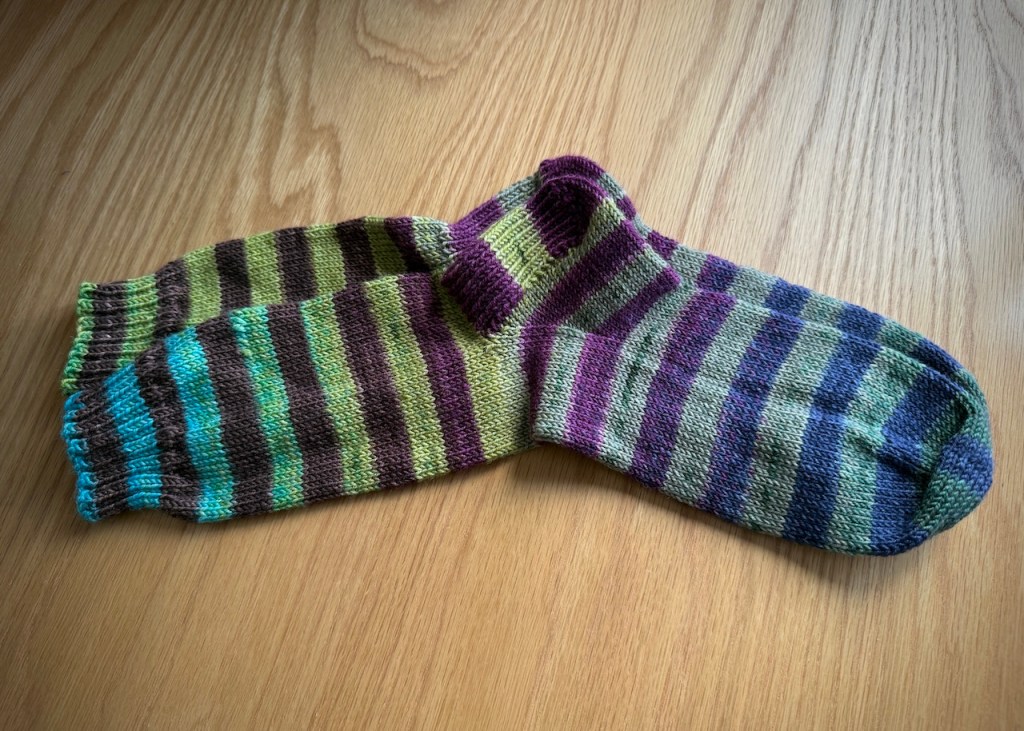
The stripe socks are finished and, if pressed to pass judgement, I would say “Despite everything, I like them.” Pressed further, I would add “I’m not really drawn to this type of striping.” However, this is something we will come back to in a while.
First, let’s talk about the good stuff, because there’s plenty of it. Once knitted up, this 75% merino wool/25% nylon mix becomes a soft, smooth, luxurious feeling material. It is a medium weight for a sock; I’ve used some yarns that end up a little thinner and some a little thicker. In practice, the thickness of the fabric means the socks will work better or worse in specific shoes. For example, I wear Dr. Martens shoes a lot of the time, but they don’t make my particular half-size so I have to round up. This means there is plenty of room for me to wear thicker hand-knit socks, indeed they improve the experience of walking in shoes that are just slightly on the large side. (We might one day explore my complex relationship with shoes and pose the question of whether I started hand-knitting socks because I couldn’t buy a pair of shoes that fit my feet once the UK embraced european shoe sizing.)
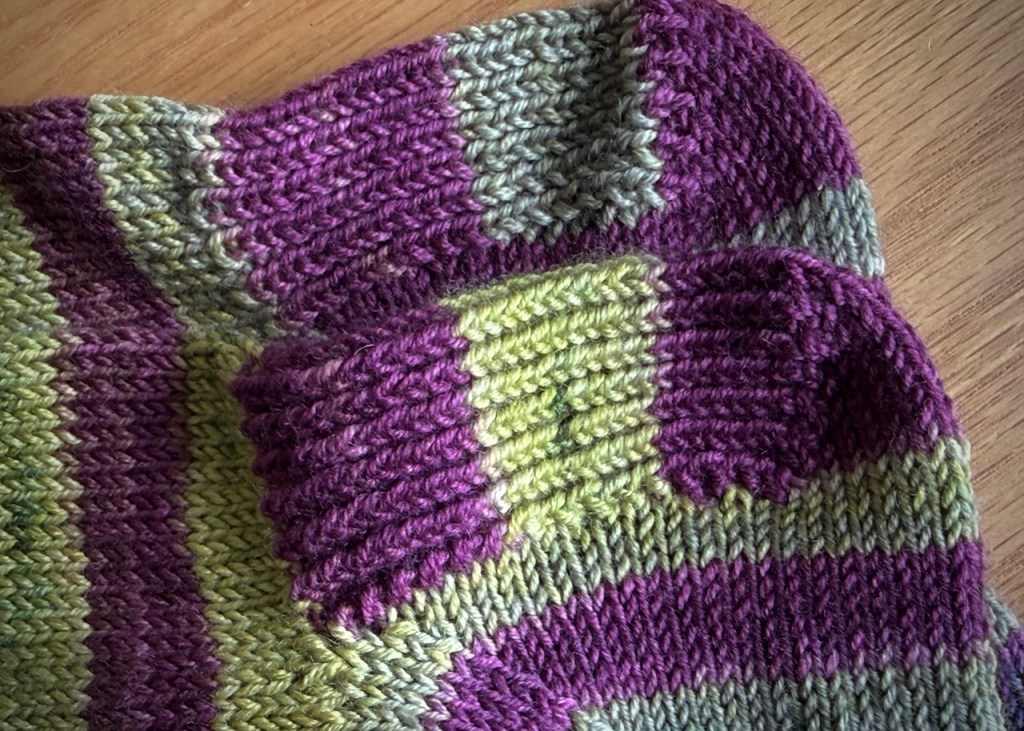
Another win for me is the way I’ve worked the heel flap on at least one of the socks. I think I used a twisted rib for this part on both socks, but they look a little different so now I’m not sure. For a twisted rib, you knit or purl the back “leg” of each stitch where you would usually knit or purl the front “leg”. I hope that this will give me a bit better fit around the heel and ankle of the socks which is an area that’s hard to get right. Some of my socks are too loose here, but if I try to change the basic pattern to make it tighter, it easily becomes too tight. To a certain extent, these socks are an experiment for this particular heel flap treatment.
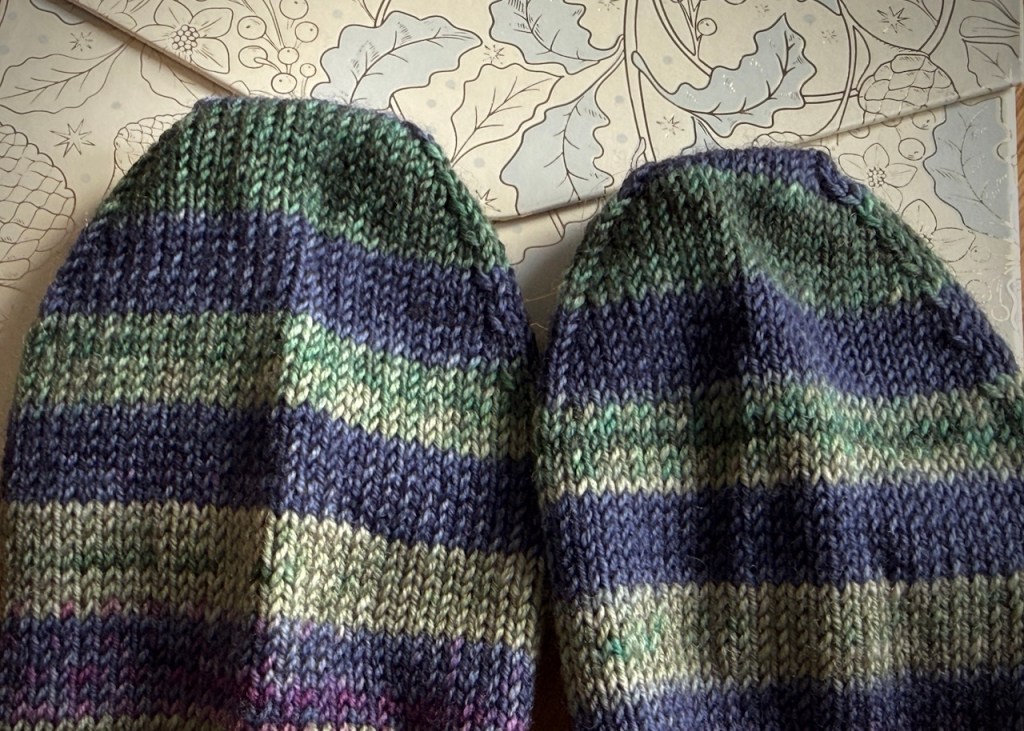
The other experimental part is a slight change to the sequence of decreases to shape the toes. In my long sock-knitting life, I have mainly worked the basic wedge toe where you work the entire toe section with alternating rounds: decreases on one round, no decreases on the next, etc. This gives an even slope to the sides of the toe “box”. This time I’ve tried a more rounded shape by working decreases on the first round followed by three plain rounds, then two repeats where the decrease round is followed by two plain rounds, then three repeats of alternating decrease and plain rounds. The final few rounds have decreases on every round until I reach the number of stitches I like for binding off as a straight edge. There probably isn’t much to choose between the two versions, but it’s good to try something a little different.
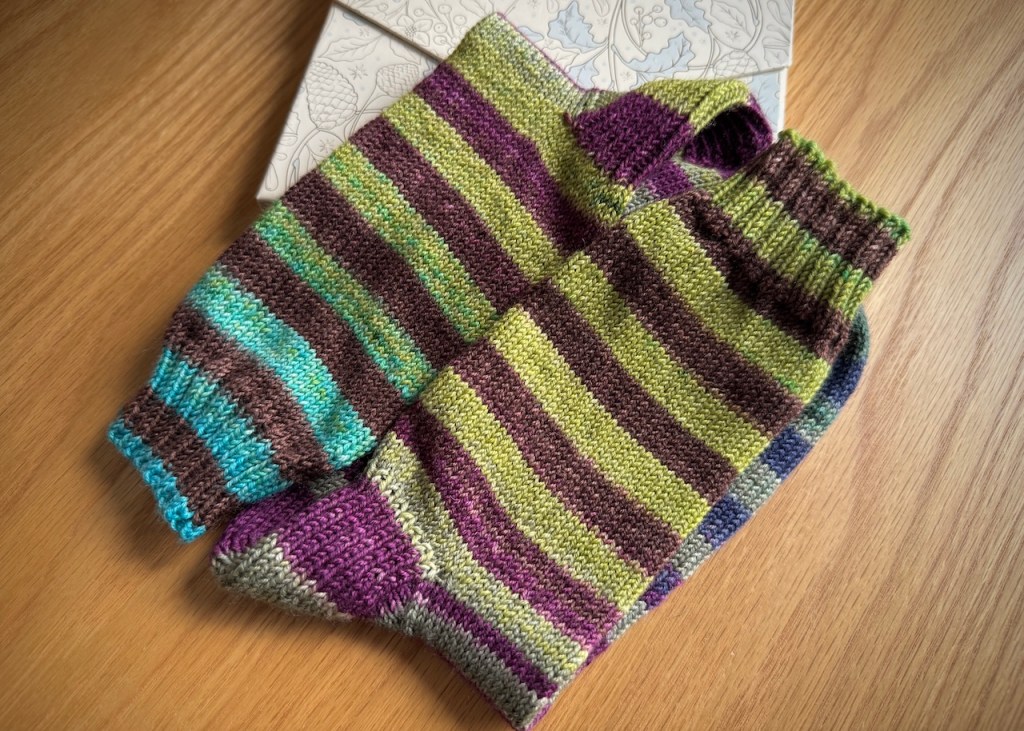
Now we must move on to the elements where I have only a luke-warm reaction to these socks. The big problem I have is with the striping sequence on this yarn. I didn’t like it when the whole of the first leg was brown and grass-green stripes. I was even less impressed when I couldn’t find a similar stretch of brown and grass-green to start the second sock. I love the brown and turquoise at the top of the second sock and I wish that had been predominant in the first sock. Until today I’ve been scoring the yarn down because of this strange sequence. However, this yarn is shown on Urth Yarns’ website made up into knee-length socks and suddenly I can see sense in the striping. I find it’s easier to accept now that the striping is perfect for the intended use, but I haven’t understood that it wouldn’t be a great yarn for shorter socks. Overall, though, I’ve concluded that I don’t like a self-striping yarn of this type and so I should avoid it in future. I prefer a speckled yarn, or the commercial ones which knit up into a Fairisle-style stripe which somehow seems more forgiving.
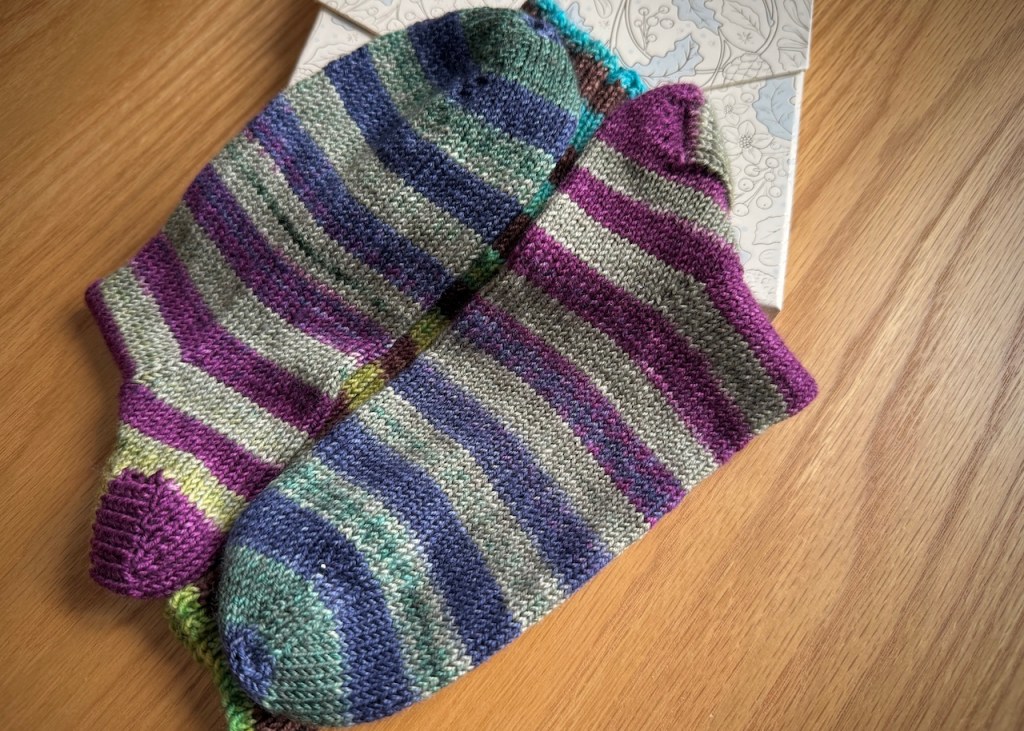
As far as the colours go, I love the turquoise, berry and blurple shades, don’t mind the grass-green and brown, but can’t find much love in my heart for the olive-greens (these last seem to show up as more grey in my photos). Again, this is a personal preference rather than a criticism of the yarn itself. The colours I liked seemed to predominate when then yarn was in a skein, but there turned out to be quite a lot of the brown and olive when I started to knit the socks.
Another slight annoyance whilst I was knitting was it was quite easy to put the needle tip through the middle of the strand of yarn as I went to knit a stitch instead of it slipping naturally into the gap at the base of the stitch. I had to pay a little more attention to make sure this wasn’t happening. I think this may be the price I pay for having such a lovely smooth finished fabic at the end.
The stripe sequencing and the splitting of the yarn made this into a project I was a little less keen to work on that I should have been. If I really put my mind to it, I could knit a pair of socks in a weekend (mind you, nowadays my hands would not forgive me if I tried), so I thought these ones took an age to make. Perhaps that is the most telling comment of all. I think of socks as a quick make and a month isn’t quick. I’m glad to have them finished and ready to go into my sock drawer and be worn. It’s only once they’re in my regular rotation that I will know how much I really like them.
The technical stuff
Pattern – Basic sock pattern that came free with a ball of sock yarn more than a decade ago.
Designed for – Any 4-ply (fingering) sock yarn.
Yarn used – Urth Yarns Uneek Sock with hand-dyed stripe sequence.
Yarn requirement – 63g (used)
Needles – 2.5mm metal double-point needle set.
Construction method – Knit cuff-down, heel flap and gusset construction, modified wedge toe closed with knitted Kitchener stitch.


2 responses to “Finished object: Stripe socks”
Good summary of things to think about when picking sock yarns. I knit only ankle length so I avoid the Urth yarns. When buying 100g skeins of sock yarn, I do wind it into ~50g balls making sure they both start at the same color point. I’m a matchy matchy sock preference.
Thanks, good point about winding the two separate balls to start at the same point. I don’t mind my socks being a little ad-hoc, but these went out of my comfort zone. Mind you, I wore them yesterday and they were lovely so all’s well that ends well.