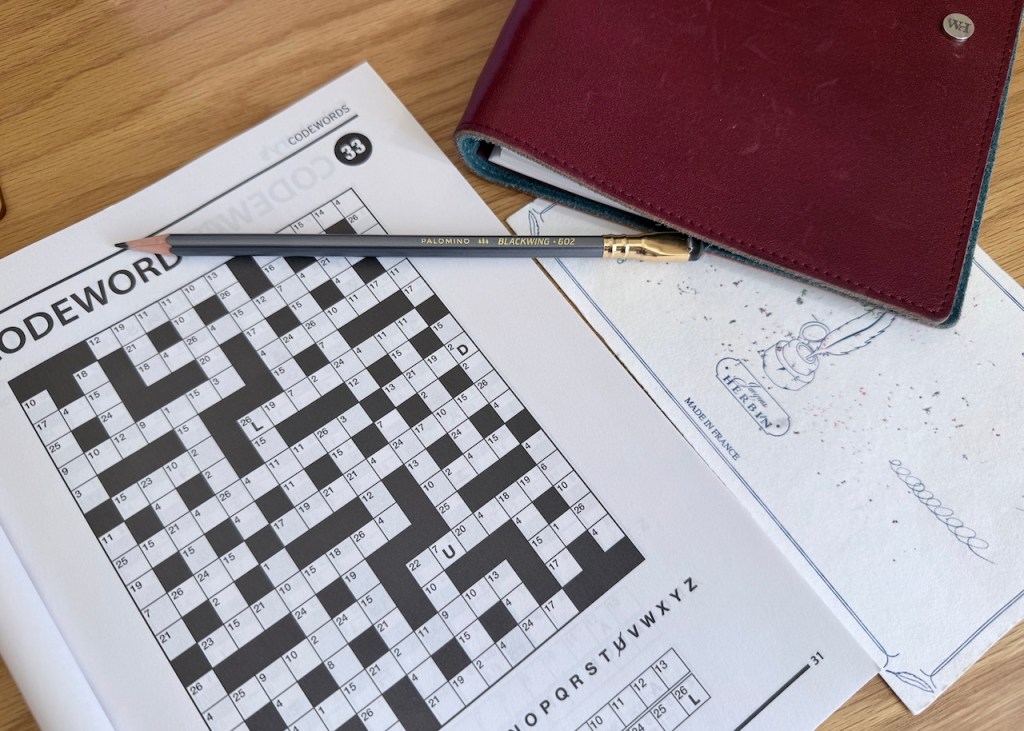
Puzzles are something that I’ve developed a taste for since retiring. Not just any puzzles, though. I’ve found my niche. Some people love Sudoku, but to me that is just lots of numbers that have to go in some kind of order which I can rarely manage to work out. Others, in their millions, enjoy a good crossword puzzle. I find these more enjoyable than Sudoku, but they often frustrate me. Especially when they veer off into the cryptic, it feels like someone is testing me to see if I belong to some kind of crossword solvers club and I’m never going to want that. Being someone who prefers words to numbers, I like a wordsearch occasionally, but I wouldn’t want to do them regularly. No, the one that’s captured me is the Codeword puzzle.
Codewords are like a crossword with an element of logic which rings my bell. For those who aren’t familiar with the concept, each letter of the alphabet is allocated a number from 1 to 26 (different in each puzzle). The puzzle has a crossword style grid, but instead of clues you are given 2 or 3 of the letters to start you off. You fill in every occurence of these letters on the grid, then you need to use your knowledge of vocabulary and your pattern-solving tendencies to work out where the other letters fit in. Some of the time I think this missing letters format keys into my ages-old training on Pitman Teeline shorthand. The first lesson on this method had you distilling words by removing unnecessary letters and just enough of it stuck to give me feel for how words might look with letters missing. As a puzzle, I find these are just challenging enough without being impossible to solve – a workout for the brain but not entirely frustrating. Perfect.
Of course, being me, there’s a whole other layer involved: the physical enjoyment of the tools I’m using. In the few months I’ve been doing these, I’ve learned that paper quality is variable and I think we all know how fussy I am about paper quality! The books I use are from supermarkets. They are released pretty much monthly and it takes me longer than a month to complete one, which can be a problem if I’m not liking the paper. I find the larger format books fine, but I made the mistake of buying a smaller version and the paper was terrible – such a shame because the size was ideal to take with me on my travels. The paper quality issue was that the print rubbed off onto the next page as you were working, so I found myself putting a sheet of blotting paper in to prevent too much transfer. It was just irritating enough to be a barrier to my enjoyment. However, I feel quite proud that I stuck with it and completed the book.
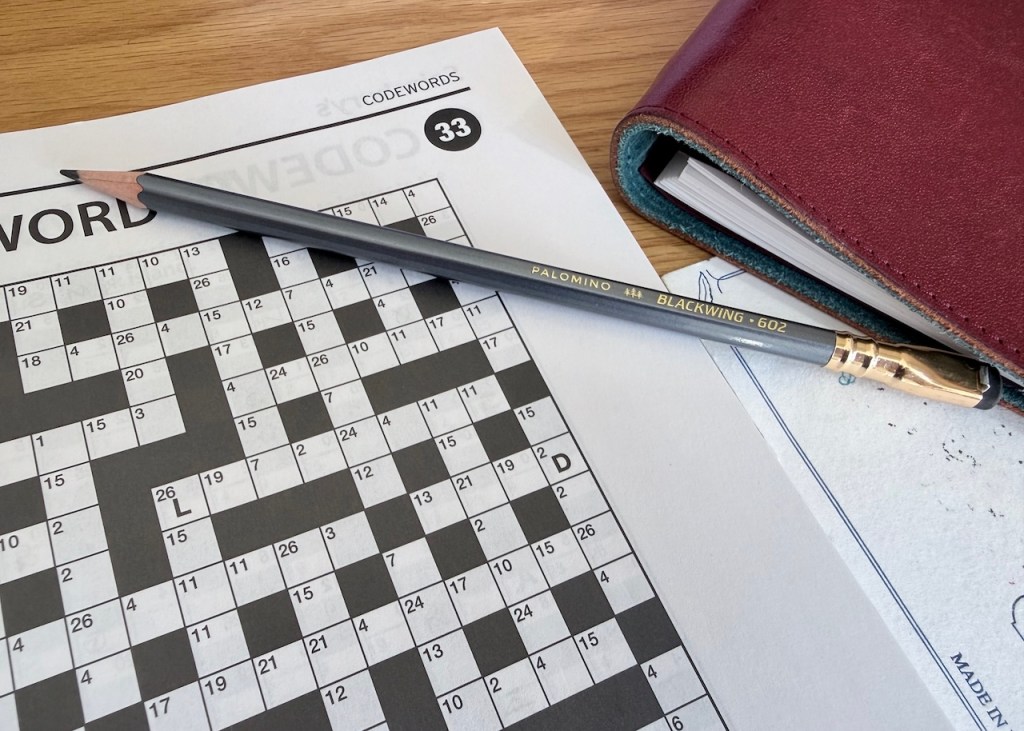
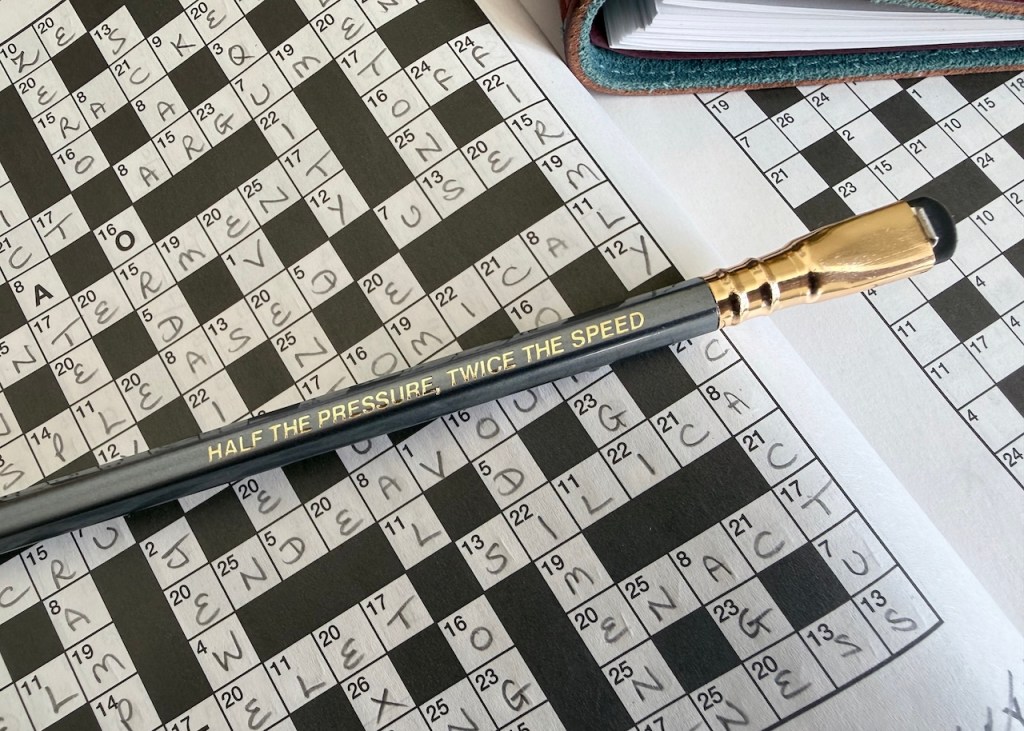
I never, even for a moment, considered this to be a passtime where I would use my fountain pens. When I started, I used biro, but quickly realised that a pencil would be better. Oh good, more fussiness to share. I’ve never liked the standard HB pencil “lead” and used to gravitate to that favourite of Shakespearean puns, the 2B. However, when I was looking for a puzzling pencil, I grabbed a Blackwing and now I’m hooked. I had two of these lying around virtually unused, both had come into my life as part of subscription boxes rather than being a considered purchase, but wow. Safe to say I won’t be buying any different pencils now.
Blackwing don’t go with the standard lead designations, but the two pencils I have both give a good, dark, semi-soft line. Hmm, I don’t actually know the jargon, I don’t speak Pencil yet. However, Blackwing’s website has a useful graphite guide which helps to take the guesswork out of the experience. I started off using my Pearl version of the pencil. This has the graphite they designate as “Balanced” and the website reveals that this is towards the softer end of the scale, though not as soft as their “Matte” graphite. This pencil is now the perfect length to fit in my pencil case when I go on holiday, so I’m keeping it for that and have moved onto the 602 version which the website shows is “Firm”, though again it’s not the most firm in their range. Certainly, it’s dark enough for my taste and, as the barrel suggests, you don’t have to press hard to get a very decent and legible script.
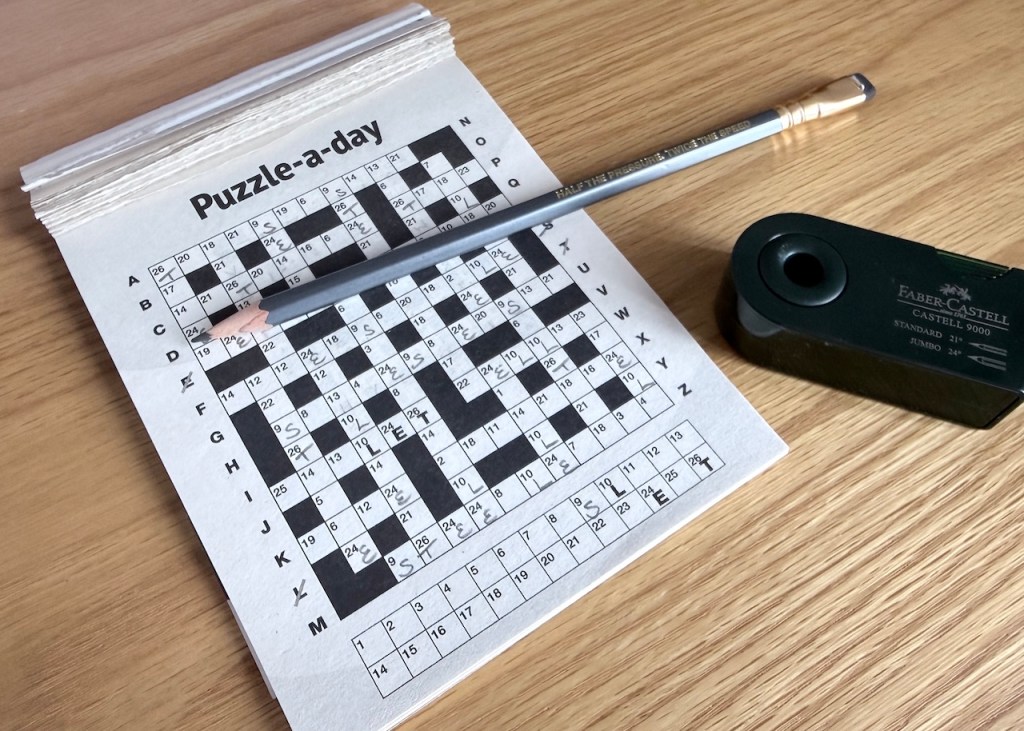
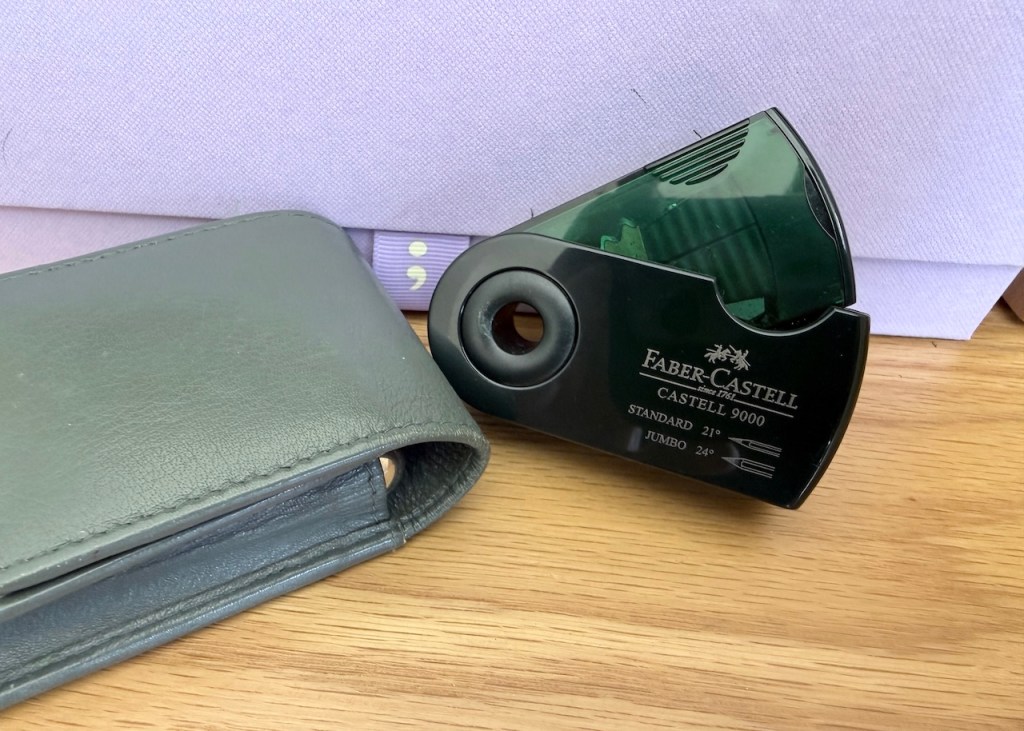
Of course, pencils come with the need for two important accessories. First, you need a pencil sharpener. I was already equipped with a basic metal one, but quickly realised that I’d quite like to upgrade to something with a box to capture the shavings. I plumped for a portable sharpener from Faber-Castell and I’ve been very pleased with it so far. The sharpening action is very smooth indeed and it’s so much easier to keep a nice point on your pencil if you don’t have to think about trotting to the bin when it starts to get blunt! I like the sharpener’s pivot action to reveal and conceal the working mechanism and to keep everything neatly enclosed when you’re moving about. It’s a dark green which looks good with my 3-pen pouch, though that’s neither here nor there.
The second accessory, an eraser, is the thing that truly makes a pencil superior to any other writing instrument. I value it in my puzzle books because I sometimes take a wild guess at a letter if no words are leaping out at me, and that can turn out to be wrong as often as it turns out to be right. No problem – just erase it and try again. Blackwing pencils come with an eraser on the end, as do many cheaper pencils. However, the higher price gets you an eraser that sits in a metal sleeve you can pull out to raise the stub as it wears down. You can even buy replacement erasers if you need them. Little things like that take function and elevate it by design. I love it.
As you can see, I’m really enjoying my pencils but don’t go thinking that this means fountain pens have fallen out of favour. The pencils have one purpose: to complete my puzzle books. Other than that I’m still 100% team fountain pen. Nothing will ever beat the experience of a good pen in the hand with a gorgeous ink flowing through a smooth nib onto dreamy, creamy paper. Pencils have simply become another tool to fascinate me and there’s nothing at all wrong with that.
And one final thought. Perhaps I ought to dig out those Pitman Teeline shorthand workbooks and refresh my skills!


9 responses to “Hmm, puzzling”
Thanks for sharing your newfound passion for Codeword puzzles. I had not come across these. Personally I am a Wordle man, for all the reasons you mention (prefer word games to numerical ones, challenging but not too challenging, etc). I no longer tackle the Wordle every day, and no longer mind missing days, but at my peak I once had a winning streak of 207 consecutive days.
I was interested to read your thoughts on puzzle book paper quality, Blackwing pencils and your nice Faber-Castell sharpener. I can see those in my future! I might give a Codeword puzzle a try.
I came to Codewords via a book of mixed puzzles including crosswords, Sudoku, wordsearch, and others (some so arcane I never did get my head around what you were meant to do). It was a good way to try things out and there were enough of each type for me to narrow down my interest to the Codewords. As I mentioned, I buy these from the magazine section at the supermarket. I’ve also seen paperback book types in The Works. I recommend that Faber-Castell sharpener, totally fits the bill.
Well, thankyou for introducing me to Codword puzzles! Since reading your post, I bought a mini book of mixed puzzles in a supermarket and tried the Codeword pages. Then, in a different supermarket I found a mini book of Codeword only puzzles. I will try these next.
I must say, I found them quite a challenge for my aged brain. A few times, I gave up and looked to the solutions. A fatal mistake is to ink in the wrong letter in multiple places, which once realised, is demoralising enough to quit.
With patience and practice, and a little bit of strategy I have improved and this is very satisfying- more so than a Wordle which is all too often over in five minutes.
I found that in the first stages, writing in the letters that are given, I would often miss squares on the first pass, which obviously made it harder. I go back and double check that I used them all now.
The next step is the hardest, analysing the grid, to find potential vowels, or pairs of letters or letters occurring several times in the same word. I play the alphabet in my head to find possible letters that would fit, then test them elsewhere in the grid before inking.
I think a larger format book would be preferable next time. I also go straight in with biro and haven’t used a pencil.
I do enjoy the mental workout, provided I solve the puzzle in the end.
Ooh, hark at me influencing people to do Codeword puzzles! I’m so glad you are enjoying them. The pad that had the lower quality paper had more puzzles that defeated me. I found there would be a run of half a dozen where I couldn’t get started and gave up. Then I hit a few which I solved, and then I went back and had another stab at the problematic ones. I managed to get most of them done in the end. Sometimes I give up and think my head isn’t in the puzzle space that day then try again another day. And, yes, isn’t it satisfying to complete one?
Yes you influenced me, and I am the better for it. It is satisfying to complete a Codeword puzzle and gives a nice tingly sense of achievement. I am heartened to know that I am not the only one who can’t get a start sometimes and gives up.
I will hunt out the larger format books next time which have bigger print for the grid numbers. However I have a pocket sized book of 150 to do first!
I came upon Blackwing pencils a couple of years ago in my enameling work. ( we can draw on etched enamel and fire the graphite in). They do a lovely creamy line. A good pencil is worth a lot.
That sounds amazing, Claudia. I love enamelled items. I can remember a brand called Micheala Frey in my youth and I so covetted their enamelled bracelets. I think I managed to save up and buy a ring. Oh, I reckon there’s probably tons of them in the ‘vintage’ pre-loved domain now.
Thanks for mentioning the Blackwing Pencils for many years I have been using Mars Lumograph pencils and it was a delight to rediscover the forgotten Blackwing pencils, I
I’m glad you were reminded of the Blackwing. The thought has crossed my mind that pencil might be the way to go for jotting quick notes when I’m walking around, mainly on trips to historic sites, where even a biro seems a bit of a faff.