
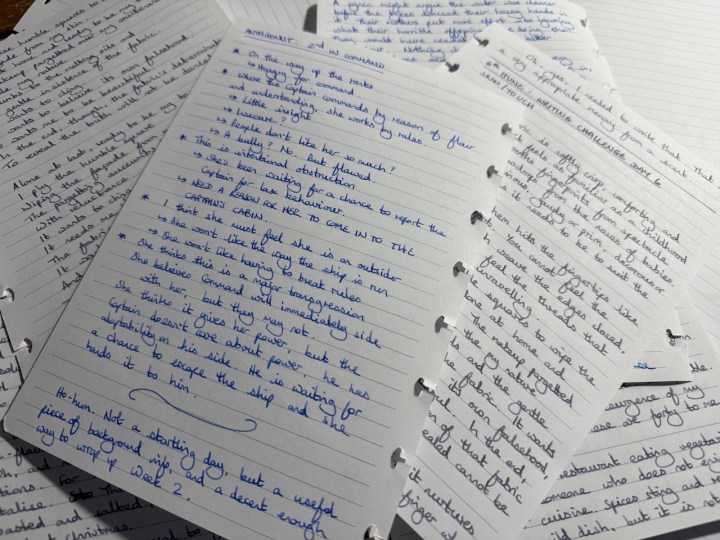
With the end of June came the end of the 30-day writing challenge. Now the dust has settled it is time to reflect on what I learned.
Lesson 1 – The habit
A writing habit is something I need to work at. It doesn’t come effortlessly. It is affected by my mood and, something that was particularly apparent through June, it is only easy when I have room in my head for it. June, it turned out, was possibly the worst month this year to undertake the challenge, what with uncertainty about my immediate future which only resolved itself towards the end of the month. This resulted in the realisation that spectacularly little is going to change from the course I had set from the beginning of the year. In some ways, though, June was the best month of all to do this challenge because if I could turn up most days in that horrid little month then I can do it in the nicer months to come.
Since the challenge ended I have been transcribing my scribblings, debating how I want to do the actual physical act of writing, and generally regrouping ready to move forward with a commitment to regular writing through the rest of the year.
Lesson 2 – disappointing output
I didn’t actually write as much as I expected which I’m disappointed about. Now all the writing has been transcribed, I find I only wrote 8,571 words in the month, an average of 295 words a day. I reckon a decent writing session should net me about 500 words. However, quantity is one thing and quality is another. I was pleased with a lot of the pieces I wrote, and when I got into the swing of writing I did manage a few days where I put in 450-500 words. Thus, I’m sure you will deduce, there were many days where I was not in the swing and managed less than 200 words. My lowest output was a paltry 90 words on the day when my brain had entirely checked out. Part of this was the challenge structure of spending a maximum of 15 minutes writing each day, although I spent more time on many of the prompts. Thinking back a few years to when I was writing much more regularly, my measure was always a word count rather than an amount of time.
lesson 3 – how much value is practice?
I think this is a question we need to ask of any creative pursuit. It is easy with creativity to get so enmeshed in practicing, because practice makes perfect, that we never move forward into creating something tangible. You don’t want to mistake the practice for the activity itself. I can see a time, when I have the space for longer writing sessions, where a daily prompt could be a warm-up session. I can also envisage days where the main writing I’m doing isn’t going so well and a prompt could be a way to keep the creative habit going. But I don’t feel that just blindly following writing prompts will get me any closer to completing stories, editing them, and getting them out into some kind of public domain.
lesson 4 – the structure of the challenge
The format of this challenge was not exactly how I’d anticipated it. I expected a simple prompt each day to stimulate a fictional piece, the actual challenge was more structured, with the prompts following on from previous ones in a more instructive format. This wasn’t a bad approach and, looking at it with an uninvolved eye, it makes a lot of sense as it allows writers from all genres to participate. There are inevitably some prompts which favour factual writing and others which favour fictional writing. I struggled most with prompts which were couched in terms of “think about a time when…” and then the instruction to write about it. The prime example of this would be the day we were instructed to write for five minutes about the best meal we have had and five minutes to write about the worst meal. I have no idea about either. Indeed, writing about a very poor meal turned out to be nothing but a whinge and I could see no value in it at all. Dear me, I already rued having wasted my time eating the meal, to go back and waste more time recalling it and writing about it seemed very counterproductive. Yes, I can see how you could mine this for a scene in which your character has to endure an unenjoyable meal, but that wasn’t how the prompt was written.
On balance, though, the majority of the prompts either sparked my enthusiasm or, as I wrote, turned into something different which I thoroughly enjoyed writing. I worked at a tangent to a couple of the prompts. There was one where I found I’d already done what one day’s prompt suggested whilst I was writing about the previous day’s prompt. That was awkward.
lesson 5: the story
The most important thing I took away from the month came from writing several pieces around a theme I’ve had cooking in my mind for years. It’s one of those stories you write a little piece of then wander away, but you never really leave it behind. My problem with it, I realised, is that it isn’t a big enough story to spin out into a novel, but it is too long to sit comfortably as a short story. That realisation alone is worth the whole month of work because at last that when I come to work on it I’ll be writing a novella.
Although I couldn’t always see it at the time, a lot of the delving we had to do during this challenge has given me a richer understanding of the character of the protagonist in this story. Not least, the revelation that to some eyes his motives could appear questionable, which makes him a more interesting character than the solid hero I had always dreamed of.
 Pam Alison Knits
4 responses to “What did I learn?”
Pam
I have found your resent blog posts quite inspiring. I admire your focus and determination. You seemed to have really got to grips with your writing via this course and you have had some really positive outcomes. I wonder if there will ever be a time when you will share your writing online?
Tim
Hi, Tim. Thank you so much for your very kind words and for supporting my little blog. I do intend to do something bloggy around my creative writing, but it’s not likely to be until I retire. I need to clear out the space in my brain which is currently reserved for Summary Hospital-level Mortality Indicators and the like. Up to that point, the challenge is to keep up a regular routine and ignore the fact that after a day of statistics and the long bus journey home, my brain is mush.
Kudos for giving it a go, even if your output was less than you hoped. Consistency is key, (so I have heard) and building a positive habit takes time.
I see what you mean about the meal prompt, but I suppose it could be interpreted as describing a meal in which there was tension or some uncomfortable atmosphere, which you could enjoy describing rather than just literally describing a bland dish.
Hi, Rupert. Thanks for commenting and, yes, your idea about the meal is so spot-on that I feel foolish for not thinking that way. Some days, I used the prompt very loosely, but other days I got bogged down in a very literal interpretation. I wonder if that’s simply reflective of where my mind was on each day. It didn’t help that the first three weeks of June were a period of instability at work, as my job didn’t appear at all in the new structure. I’m glad to say that was resolved by the end of the month and I am now back on the course I set at the beginning of the year.