My Filofax Holborn personal-sized planner keeps going from strength to strength and, apart from occasionally wondering whether the week-to-view diary is the best option, I have no intention of changing it for the foreseeable future. However, it’s become clear to me over the last couple of months that there are two areas of my life which need something else, something more, something different. Areas where I need to be more expansive than the 171 x 95mm personal-sized pages allow. As I pondered this, I found that Filofax had an offer on their personalised looseleaf notebooks, so I took a dive and this is what I found.
Filofax currently offer two refillable options: their standard rings system such as my Holborn, and a spiral-bound system with pages punched in the way that you would find in a disc-bound system such as William Hannah’s magnificent offerings. I’ve used both types during my years with Filofax and when I thought about a format for my purpose-driven planners, I gravitated to the spiral system. This has several things going for it: reasonable price, A5 pages, compact and lightweight, paper I like the quality of. Now I’ve been using the planners for a few weeks I wanted to share my experience, not least because this style of planner doesn’t really get much exposure.
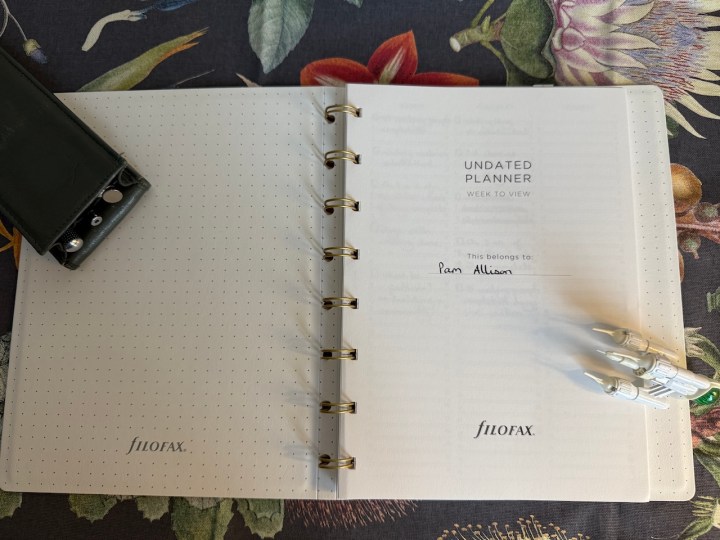
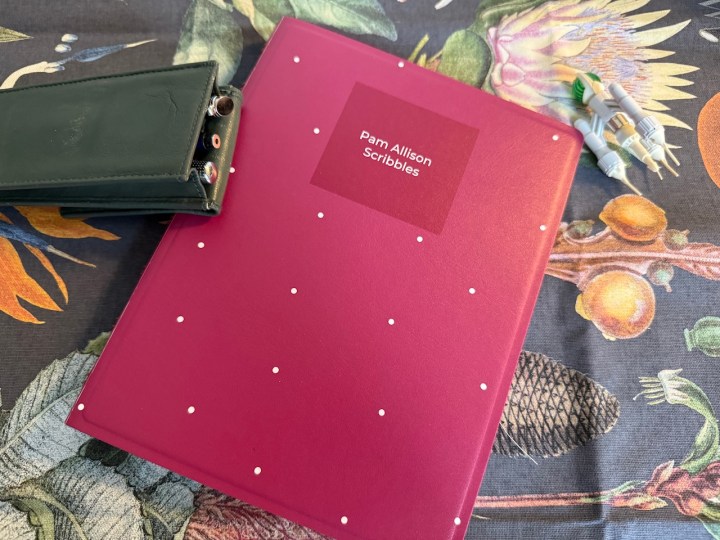
Starting from the outside, let’s look at the cover, and let’s address materials because Filofax use different covers for different options. Some of their standard refillable notebooks, those that have lined, squared or dot grid pages but no diary, have laminated cardboard covers, others are plastic. The covers in the “Design your own planner” option are all plastic and, not only that, but they have quite a distinctive smell which may be a result of the personalisation process. That smell really is the only downside I can see to this planner so I wanted to get it out into the open right from the start. If you can ignore the aroma, you can choose from 125 designs at present count, and then you can have a personalised title added to any of the designs. The personalisation sits in a title block; you get some choice over the colours and sizes both of the block and up to three lines of the text. I think they’ve got this spot-on – there’s enough leeway for you to be creative, whilst ring-fencing enough to make sure the overall design remains consistent. I chose a spotty cover for my writing planner with simple text and I like how this has turned out. Inside, the cover is white with a dot-grid pattern and a simple “fILOFAX” logo. I hate that first lower case F but that’s the price we pay to be modern. This is a minimal cover, no pockets, no pen loops, nothing fancy whatsoever. That, of course, means it’s small, it’s lightweight and it’s portable.
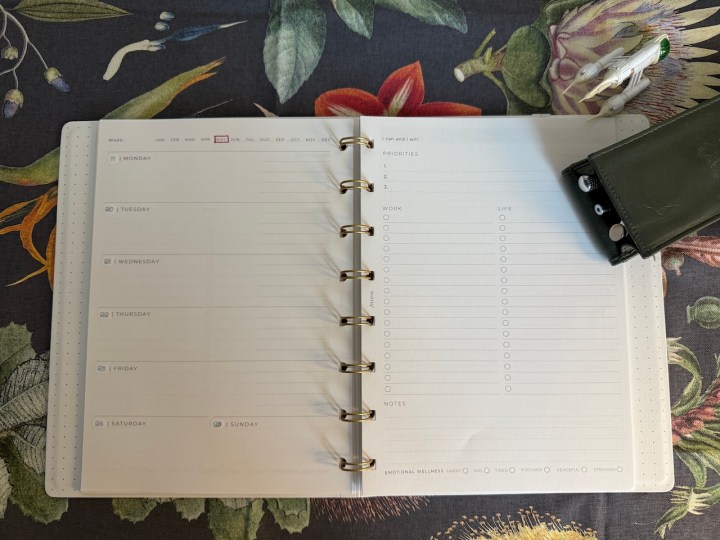
The insert choice is also pretty good. The first thing to decide is whether to go with a dated insert on 80gsm or 90gsm paper, or an undated version on 100gsm paper. I’ve used the 100gsm paper in the past and it is good with fountain pen ink, so I chose that. Once you’ve made your way to the undated pages, the main choice for the diary is vertical or horizontal week to view. The vertical week to view spans both pages and each day has space for appointments then a task area below. Saturday and Sunday share one column. Spaces are set aside for top 3 priorities, the week’s main goals and notes for next week. I opted for the horizontal layout which also has room for the same items, but groups them on the right-hand page whilst the left side is essentially a week-to-page diary. Once again, Saturday and Sunday share a space. There’s also a quote for each week and a “mood” tracker – I find these unnecessary but not intrusive. You get 12 months of diary pages and, if you go for the dated version, you can choose your start and end month (right now it’s got options right through to April 2026-March 2027). I really like that because it allows you to live by a non-standard year if you want to.
Now I’ve started using them, I like the page layout I chose and the paper is, as expected, good with fountain pen ink. I like to keep four months of pages in my diaries so I’m planning the year across three distinct “terms”. I’ve added lined notepaper to complete my notebook, but the planners don’t include this as standard. You can buy the lined paper from Filofax, punched to suit the notebook system, but I’ve got plenty of William Hannah paper which also works pretty well (I actually re-punch it in order to have a little extra ease when turning the pages). Filofax sell a hole punch for their looseleaf notebook system, but I have one from Staples which works for both this and the William Hannah disc system. This means you can punch any paper to suit and that opens up a whole host of options to you.
My planner is devoted to creative writing, which I’m trying to get back into in the lead-up to my retirement next year. As a planner with one specific purpose, I find this notebook style works very well. I don’t think I would choose it to be my main daily carry; it doesn’t seem as robust as a good leather cover and I still prefer rings over the spiral binding. That said, I think this notebook has advantages of portability over an A5 ring cover.
There is one other important aspect that needs to be taken into account when considering this as a planner option. At present, you can’t buy the planner refill which I’ve described on its own – you have to buy it complete with a cover. So once the year is done you’re back to whatever choice they have in their standard dated planner pages for the system or you have to order another notebook. I hope that changes – they have a good process set up for personalised refills for their ringed covers and there must be potential there to add the spiral-punched pages in the future.
On the whole, I can recommend the Filofax notebook if you’re looking for a cost-effective, lightweight, compact diary that’s going to see relatively light use and if you don’t mind the smell because I can see that being a deal-breaker. I’ve got a feeling the laminated cardboard cover would be nicer, but my guess is that this would make the personalisation process too difficult. The design-your-own-notebook currently costs £25 from Filofax UK. This is half the price of their cheapest A5 ring planner if we ignore the hideous Clipbook and any sale items. As I alluded to at the start of this review, I took advantage of an offer on the website to take 33% off the cost of the planner and it’s always worth keeping an eye out for bargains like that. I can imagine this being a great gift for a younger relation who is keen to get into planners or just needs to be better organised. It might be fun for them to design their own cover and choose the type of pages they want to go with. It’s proving ideal for the use I’m putting it to, but it hasn’t yet wormed its way into my heart. Time will tell.
 Pam Alison Knits
One response to “Scribbles – a notebook review”
[…] Scribbles – a notebook review – Pam Alison Knits […]