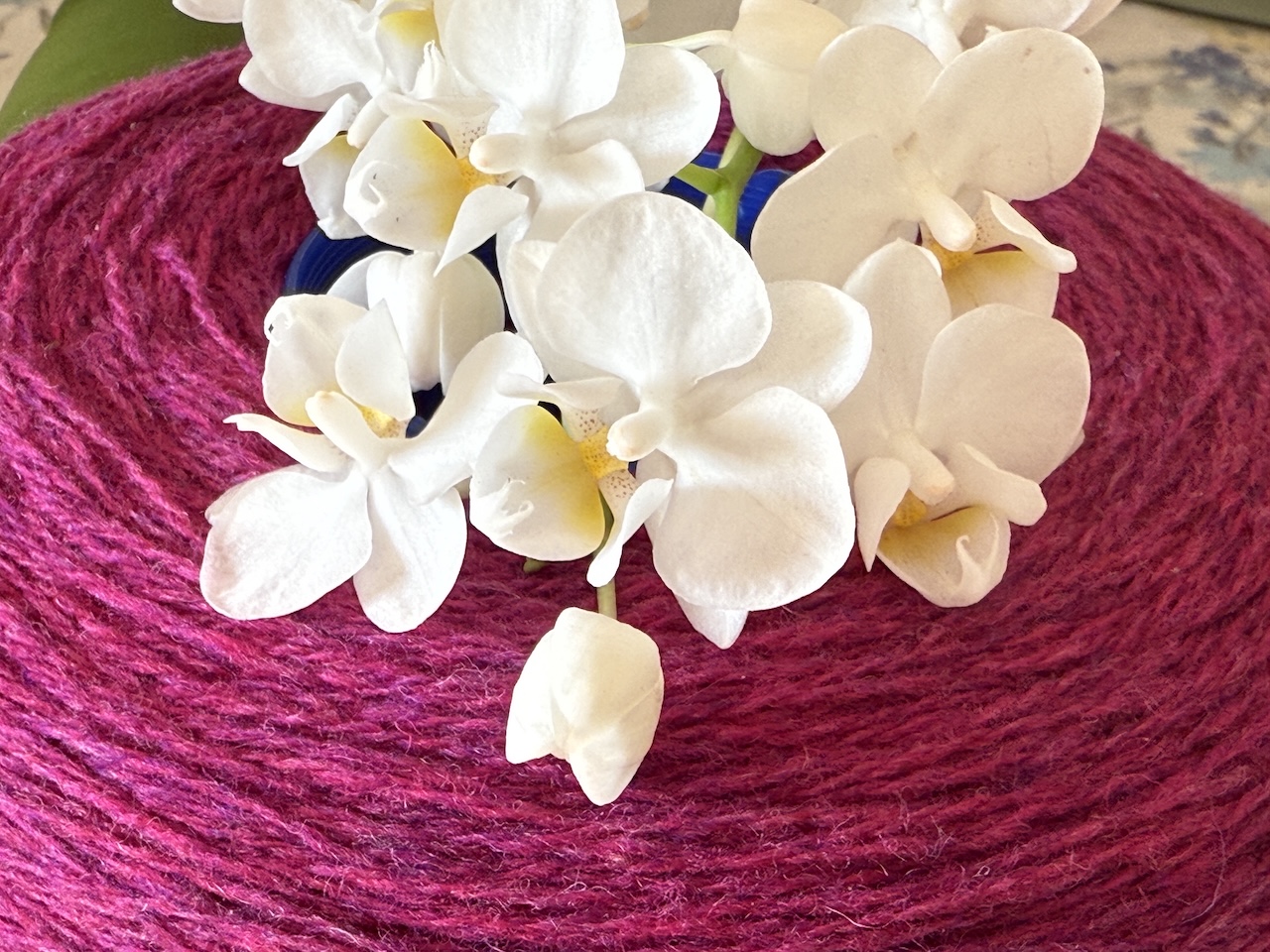

The 1986 is done, hurrah, so it’s the ideal time to have a chat about how it all went and perhaps touch on some technical details. The headline, though, is that I love it!

The finished garment is loose and hits below my hip. To begin with, I thought that might be a little longer than ideal, but now it’s washed and pressed I find it’s just perfect. The yarn knit up into a very fine and airy fabric which, if I’m honest, is a bit of a surprise. I used 3.25mm needles for the main part of the knitting (the ribs are always worked with slightly smaller diameter needles) but I could probably have gone for 3mm instead and come closer to the density I’d expect from a 4-ply/fingering yarn, but more on that later. I was aiming for a finished chest measurement of 42″ based on my gauge calculations, and ended up with 48″. Would I have liked the finished result as much if I’d been closer to my expectations? Probably – it would not have been the same, but it would have been equally lovely.
The yarn is Bio Shetland, 100% pure organic wool. It’s made in Turkey for the Danish brand BC Garn. The ball band information is what I would term as very “modern” – it’s so busy making sure the information suits as broad a base of knitters as possible that it fails to give me what I, as an older knitter, need.
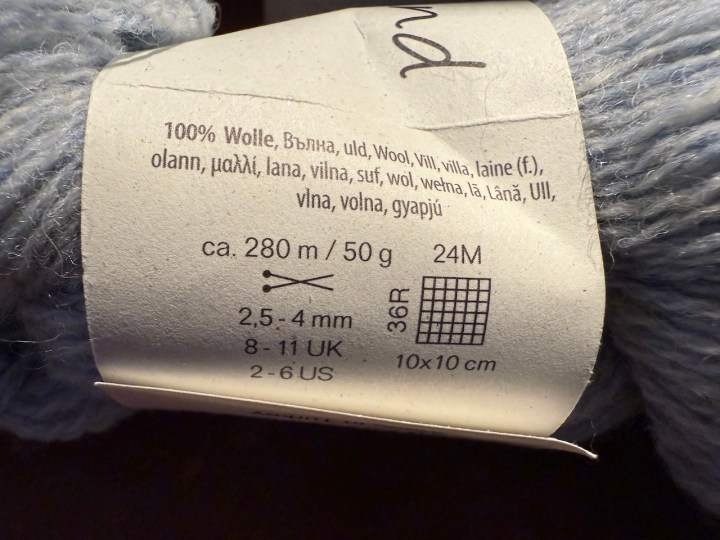
As well as the fibre content, the band gives the approximate metreage per 50g, the suggested needle size, and the number of stitches and rows you might expect to obtain in 10 sqaure centimetres of knitting. So far, so good. I’ve always tended to look to the average gauge, in particular the number of stitches per 10cm, to guide me as to the kind of yarn thickness I’m looking at, but I’ve got to stop doing that because it means absolutely nothing now. In the “olden days” the information would be much more dictatorial – it would pretty much say “using x needles you should obtain a gauge of y” and you were expected to have the skills to understand that if you didn’t get “y” you needed to try with different needles until you did get “y”. With 4-ply wool, you’d knit with 3.25mm needles and be expected to get 28 stitches to 4cm. With a double-knitting wool (DK) you’d knit with 4mm needles and be expected to get 22 stitches to 4cm. Using that as my guide, I expected this wool to sit between a 4-ply and a double-knitting wool, but that is a very, very foolish assumption. I had already twigged that this was more of a 4-ply wool weight so I went with 3.25mm needles. In fact, this is lighter than the average 4-ply and I reckon you could use it as a substitute for 3-ply weight wool in really vintage (i.e. 1930s and 1940s) knitting patterns.
To return from that unintentional cul-de-sac to some actual project data, I started with seven 50g skeins of this yarn and this project used exactly half of it. I still have 180g left. When I say this is an airy top, I’m not kidding. Other than knitting the self-same top again, what could I do with 180g (1008 metres) of this lightweight, pale wool? Well, it’s quite fortuitous that I happen to have 1600 metres of a co-ordinating wool/silk blend laceweight tucked away for a rainy day. I reckon one day I’ll be happy to knit these two together into a nice 4-ply cardigan.

I cast on The 1986 at Christmas and finished it on 18th February, so it took 8 weeks. I stumbled a bit when it came to picking up the stitches for the armholes as I struggled to pick up the same number on the front as I had on the back. That put me in a bit of a spin and I set it aside for a week or more then, coming back to it with fresh eyes, I just made it work. A case of over-thinking things to begin with and convincing myself that I’d done something seriously wrong with the whole garment instead of just going with the evidence of my own eyes.
The main modification I did to the written pattern was to cast on the full number of stitches rather than working the rib on a reduced number of stitches then increasing. That was absolutely the right decision. With this floaty fabric, and the longer length, the looser bottom band is exactly what’s needed. It may be The 1986, but I’m wearing it in 2025 and we’ve got to be real here. This is not a garment for dressing up in 1980s style – it was always meant to be a piece that would work with my real wardrobe in the current era. As such, it’s worked out perfectly and I’m looking forward to seeing how it looks with various outfits just as soon as the weather gets a little warmer.
 Pam Alison Knits