
I have passed the 6-month mark using the Waterman Hemisphere L’Essence du Bleu, my Christmas present to myself, and it’s marching on towards a year since I actually bought it. High time, then, to catch up and ask myself whether or not it was a wise purchase. I already own three Hemispheres and the danger was that this fourth one would be superfluous.

The first thing to ponder is whether there is, or ever can be, much to differentiate one mass-produced pen from another of similar proportions. I suspect that the differences are miniscule, especially when you go further and look at pens from the same manufacturer and then from the same model line. The whole point of mass-production is to streamline the experience and make every individual item as close as possible to every other. Then again, as any fountain pen user will tell you, the variation between one nib and the next can be huge – in fact, it can be the difference between a pen that works and one that doesn’t work – so we must consider that minor factors can have a big impact in how much you enjoy using a pen. In my experience, Waterman’s steel nibs tend to be pretty consistent and the Fine nib fitted to this pen is an excellent example with an ink flow that is neither stingy nor gushing. The writing experience is smooth with a bit of feedback, especially when I first started using it, but never scratchy. In this it is on a par with my existing Hemispheres as I can’t say I have problems with any of the nibs.

Like all of the current Waterman fountain pen range, the Hemisphere uses ink cartridges or a converter which is part of the attraction for me since this is my preferred filling system. Paired with a fine or extra fine nib, a cartridge or a fill of the converter gives an entirely adequate quantity of ink. I reckon to get about 20 pages of writing out of one fill, and I’m usually ready to move on to a new colour by the end of 20 pages. So it’s been a bit of a surprise to me how much I have stuck with blue inks in this pen. For some reason they have made me so happy.
* I started with a cartridge of Montblanc Midnight Blue – this wrote a little paler from the fine Waterman nib than it does in the Montblanc slimline, but still a good benchmark for others.
* Next up, I moved on to Graf von Faber-Castell Cobalt Blue which is a brighter blue with less of the grey-green tinge which the Midnight Blue had exhibited. This made me very happy indeed.
* Back to more of a green shade next: Diamine’s Aurora Borealis which exhibited a bit of shading between the wetter and drier strokes of the nib.
* Herbin’s Cacao du Bresil followed on from the Diamine ink and this was a big step away from the blue shades. In writing, it reminds me of the Montblanc Midnight, not because they are similar colours, but they share a muted tone whilst still remaining legible.
* Back to blue, but this time the bright seaside vibes of Waterman’s Inspired Blue. I’m surprised to find I didn’t use that at all in my journal and I can’t remember whether I disliked the pairing or just used it on other things.
* Through June I filled the pen twice with Graf von Faber-Castell’s Cobalt shade. This is hands-down my favourite ink to use with this pen, being well-lubricated and laying down a solid line with no real variation. It could be boring, if it weren’t such a vibrant and compelling shade of blue.
* Taking me up to the present, I slotted in a random blue ink cartridge I had lying around. It might be a Waterman cartridge – it’s the long standard size which Waterman do tend to include in their pen boxes in lieu of a converter – but it could equally well be something else. It was surprisingly good, just a little less good than the Cobalt Blue I’d been using before.
To sum up, the pen has been inked almost continually for the past 6 months and that, if nothing else, speaks volumes about how much I enjoy using it.
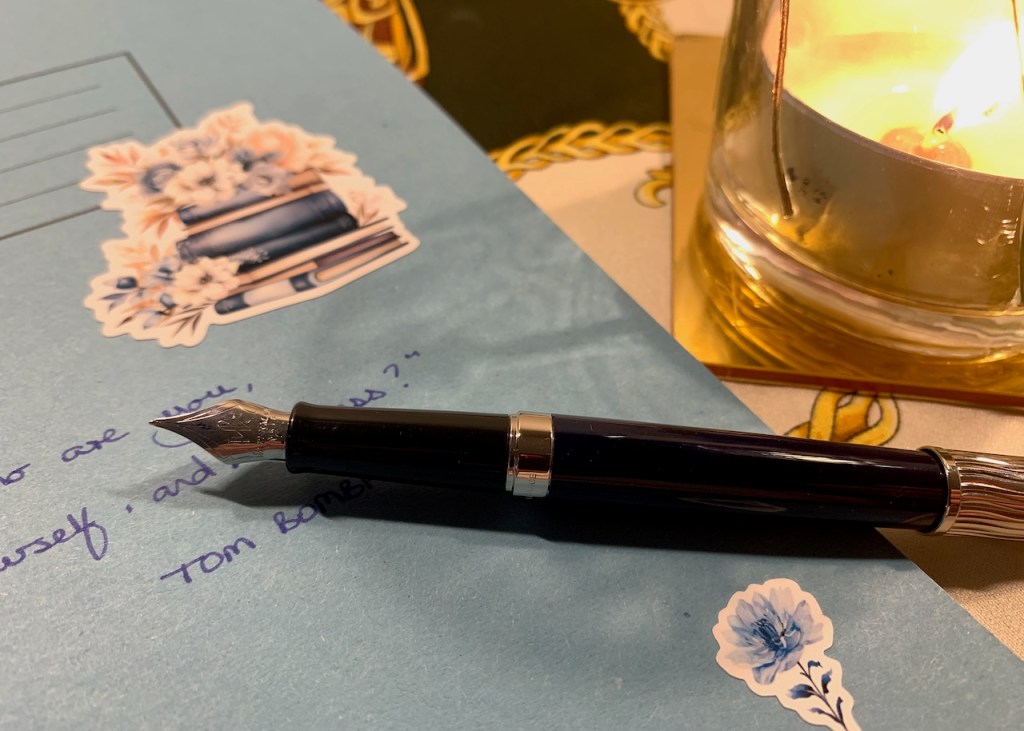
Technically speaking, the elements of a fountain pen which should most influence enjoyment are the nib/feed, the filling mechanism, and the seal between the cap and the body. If a nib is scratchy, or doesn’t have any control over the flow of the ink, or (in extreme examples) doesn’t actually lay down any ink at all, then we can’t possibly enjoy our pen. Similarly, if the filling mechanism does not function well or does not hold the right quantity of ink for the use we’ll put the pen to, then it’s another huge bar to enjoyment. A poor seal between cap and body will lead to the ink drying in the nib if the pen stands idle for too long, with all the associated irritation of hard starts. But a fountain pen is so much more than a technical instrument. Each pen brings its own personality into the equation, there is a sensory connection with us as we use it: the looks of the pen, the sounds, the feel, they all play into how much we want to use a pen.
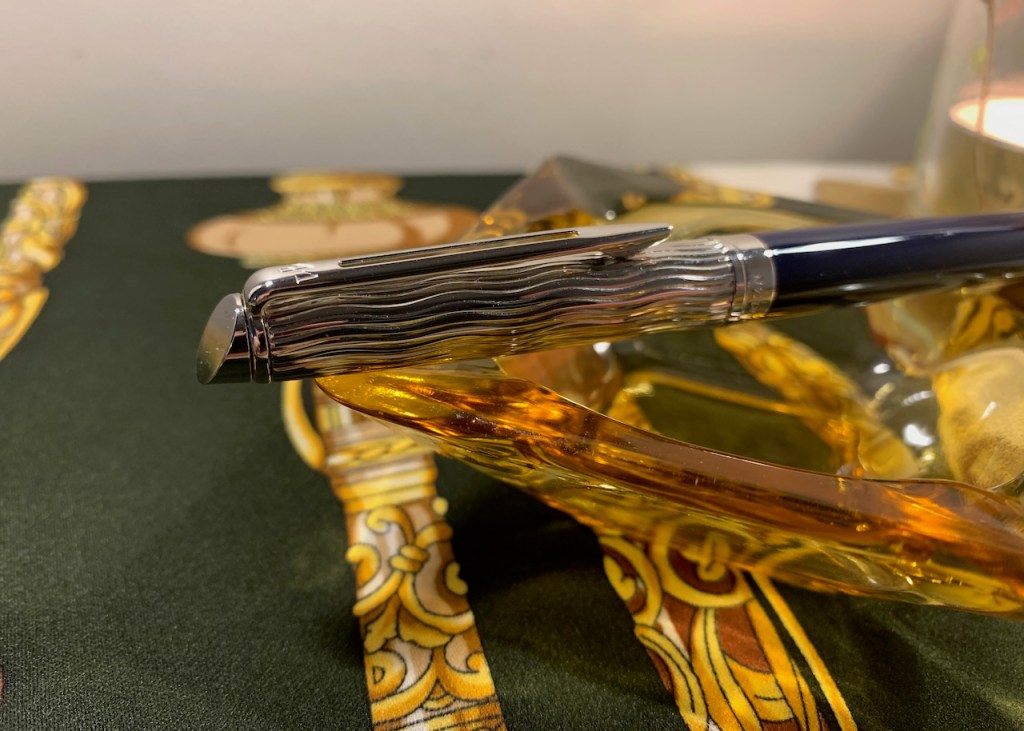
I think, for me, the defining element of the L’Essence du Bleu Hemisphere is that cap. The chiselled ripples are not only visually compelling, but also lend an added tactile element. I just love looking at the pen and that is what has kept me inking it up and turning to it throughout the past six months. This is what makes it a very wise purchase, a pen that I want to keep in my collection forever. Has it pushed my existing Hemispheres out of rotation? Yes, a little bit. Perhaps I need to occasionally let the L’Essence du Bleu have a turn in the pen case and use one of its brothers instead. Or have a month when I ink them all up and give them an equal bite of the cherry, see how they really compare, one against the next.
Do I have any regrets over this purchase? Perhaps one: the thought that I should have really pushed the boat out and bought the Carène instead of the Hemisphere. Then again, I don’t have a history of enjoying gold nibs, and maybe the Carène would not have suited me quite so well as its more budget-friendly little sibling. So, on second thoughts, no; no regrets whatsoever.
 Pam Alison Knits
One response to “Je ne regrette rien”
Tres bien! It is good to hear that your special Hemisphere Essence du bleu has been in continuous service and still gives you pleasure. It is lovely when that happens.
I too am a fan of GvFC Cobalt Blue, although recently I have discovered Diamine Oxford Blue, which is also extremely pleasing. No matter what colours I try, I usually come back to Blue in the end.